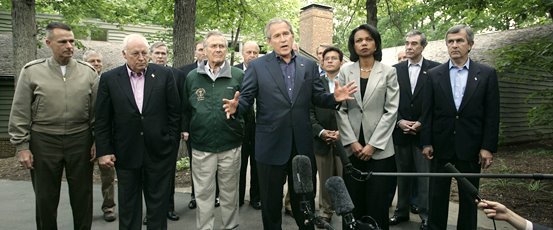
Here we come, to save the day. Hey, hey, we're the Bush
team
White House Hones a Strategy for Post-Zarqawi Era
By DAVID E. SANGER and JIM RUTENBERG
THURMONT, Md., June 12 — President Bush gathered top aides at Camp David here on Monday to calibrate the best way forward in Iraq during what the administration described as a critical juncture, following the death last week of the most-wanted terrorist in Iraq and the final formation of a unity government there.
The meeting was as much a media event as it was a high-level strategy session, devised to send a message that this is "an important break point for the Iraqi people and for our mission in Iraq from the standpoint of the American people," in the words of the White House counselor, Dan Bartlett.
It came as Republicans began a new effort to use last week's events to turn the war to their political advantage after months of anxiety, and to sharpen attacks against Democrats. On Monday night, the president's top political strategist, Karl Rove, told supporters in New Hampshire that if the Democrats had their way, Iraq would fall to terrorists and Abu Musab al-Zarqawi would not have been killed.
"When it gets tough, and when it gets difficult, they fall back on that party's old pattern of cutting and running," Mr. Rove said at a state Republican Party gathering in Manchester
So how many members of the Rove family are now serving in Iraq?
Oil, Politics and Bloodshed Corrupt an Iraqi City
By SABRINA TAVERNISE and QAIS MIZHER
Published: June 13, 2006
BASRA, Iraq — Politics, once seen as a solution to the problems of a society broken by years of brutal single-party rule, has paralyzed the heart of Iraq's south.Yeah, the post-Zarqawi era.
British soldiers search a motorcyclist and his rider in Basra, where there has been a sharp rise in sectarian violence, some of it officially supported.
After a roadside bomb destroyed a British vehicle last month in Basra, wounding two, Iraqis poured gasoline on the flames from above.
This once-quiet city of riverside promenades was among the most receptive to the American invasion. Now, three years later, it is being pulled apart by Shiite political parties that want to control the region and its biggest prize, oil. But in today's Iraq, politics and power flow from the guns of militias, and negotiating has been a bloody process.
"We're into political porridge, that's what's changed," said Brig. James Everard, commander of the British forces in Basra. "It's mafia-type politics down here."
Police reports from the past five months read like war chronicles: Eight oil company employees murdered. Twenty caches of Russian rockets discovered, including a pile in the back of an ambulance. A tank of stolen oil found in a fake mosque. Shootouts reported between a politician's militia and the police, and between police officers.
Now, after two years of relative calm, Basra has a soaring murder rate (the 85 killings in May were nearly triple the number in January), a tattered oil industry and a terrified population.
"I cannot talk with you," said Sajid Saad Hassan, a professor at Basra University's agriculture college. "I haven't joined a party and no militia is protecting me."
.

No comments:
Post a Comment